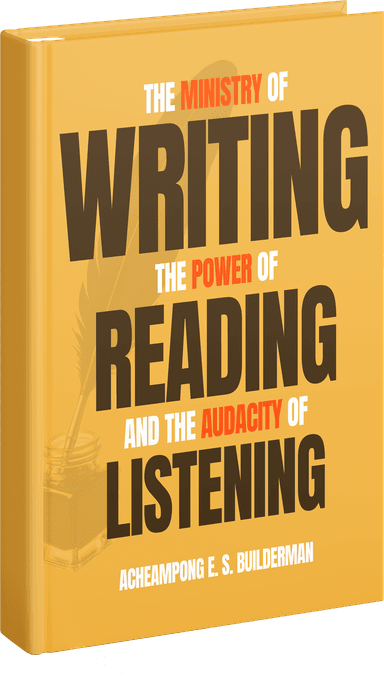
There is a particular kind of book that does not simply ask to be read. It asks to be obeyed. The Ministry of Writing, The Power of Reading, and The Audacity of Listening by Reverend Acheampong E. S. Builderman is exactly that kind of book.
It opens with a boy and a piece of chalk. His mother is guiding his small hand across a slate, and what looks like a lesson in penmanship is, we soon realise, the laying of a foundation. Then an uncle arrives and hands the same boy a newspaper every morning, demanding a summary. What emerges from these two ordinary acts of love is the architecture of an entire life, and eventually, the architecture of this book.
Reverend Builderman's central claim is simple enough to fit on a placard and large enough to reorder how you think about civilisation itself. Writing, reading, and listening are not three separate skills competing for your time. They are one discipline wearing three faces, the hand, the eye, and the ear, and where one weakens, the others cannot compensate for long. Neglect all three, he warns, and a people begins to vanish, not through conquest but through forgetting.
What makes this book more than another call to read more books is its theology. Reverend Builderman does not treat writing as a hobby attached to ministry. He treats it as ministry itself, tracing it back to a God who wrote the Law with His own finger before any prophet ever picked up a pen. Reading becomes an act of liberation, illustrated through Frederick Douglass, whose captors understood, as clearly as Douglass did, that a mind that can read cannot be easily owned. And listening, the discipline most books like this one tend to skip, is given equal and even primary weight. Faith, he reminds us, comes by hearing. The ear, he argues, is the root beneath the visible tree of writing and reading, and a world that has learned to hear everything while listening to almost nothing is a world in quiet danger.
The book carries a distinctly African urgency without ever narrowing into a regional argument. Builderman walks readers through Timbuktu and Fez, through libraries that predate Oxford by centuries, insisting that Africa's story was never one of intellectual absence but of interrupted transmission. His challenge to a rising generation is blunt. Until the lion learns to write, every story will glorify the hunter.
There is real tenderness here too, particularly in the chapter that lingers longest in the mind, the one about the people who die with books still inside them. The graveyard, Builderman writes, is the richest place on earth, filled not with gold but with testimonies never recorded, wisdom never passed on, songs never released. It reads less like criticism and more like a plea.
By the final pages, the book has stopped being merely informative and has become something closer to a commission. Pick up the pen. Open the book. Incline the ear. Begin. It is not a suggestion so much as an inheritance being handed over, and the reader is left with the distinct sense that putting the book down without acting on it would be its own small tragedy.